Central City
On the RoadCentral City is a former Colorado mining town whose silver-boom history and revived opera season make it a stage for a brief but revealing collision of respectable culture and road-born disorder. On his first view of the Rocky Mountain interior, Sal Paradise finds a town where tourists gather around an opera house built amid miners’ shacks, while a weekend party in a dusty miner’s cabin moves from communal cleanup to drunken tumult. Central City’s significance lies in that double life: it presents the West as both a curated historical attraction and a landscape of exhilarated, precarious freedom.
A Mining Town Remade
Central City had once been called the Richest Square Mile in the World, after silver was found in the hills by miners who grew rich quickly. In the boom’s wake, an opera house rose among the steep-slope shacks. Lillian Russell and opera stars from Europe had performed there, but the town later became a ghost town. Its revival came through the efforts of the new West’s Chamber of Commerce, which polished the opera house and brought stars from the Metropolitan Opera each summer. Tourists arrived from across the country, including Hollywood visitors, turning the old mining settlement into a seasonal destination.
That history is visible in the town’s contrast of scale and setting: an elegant musical institution among rough dwellings on a mountainside. When Sal arrives with Babe Rawlins, Ray Rawlins, and Tim Gray, the narrow streets are crowded with stylish tourists. Roland Major, already there, enthusiastically marvels that opera had been performed in the town decades earlier; Sal answers by pointing out that the tourists are there now. Major curses the visitors, then goes off to enjoy himself. The exchange captures a place whose past is celebrated and repackaged even as its present is consumed as spectacle.
The Opera and Sal’s Double Vision
The weekend separates Sal from Dean Moriarty and Carlo Marx for five days. While his friends are elsewhere, Sal attends the opera as Babe’s escort, wearing Tim’s suit. Only days earlier he had entered Denver looking like a tramp; now, neatly dressed beside a well-dressed blonde, he bows to dignitaries and chats beneath the lobby chandeliers. The abrupt shift in appearance and company makes Central City a temporary passage between the road’s unsettled life and the forms of social polish surrounding the opera.
The production is Beethoven’s Fidelio. Sal is moved by the baritone’s emergence from a dungeon beneath a groaning stone, and the opera’s gloom briefly absorbs him so fully that he forgets the circumstances of his own life. When Denver D. Doll asks what he thought of the production, Sal repeats his response: “What gloom, what gloom.” His reaction does not reduce the opera to an amusing diversion. Its mournful sounds offer a distinct emotional register, one that interrupts the frenetic outward movement of the road without resolving it.
The Miner’s Shack and the Party
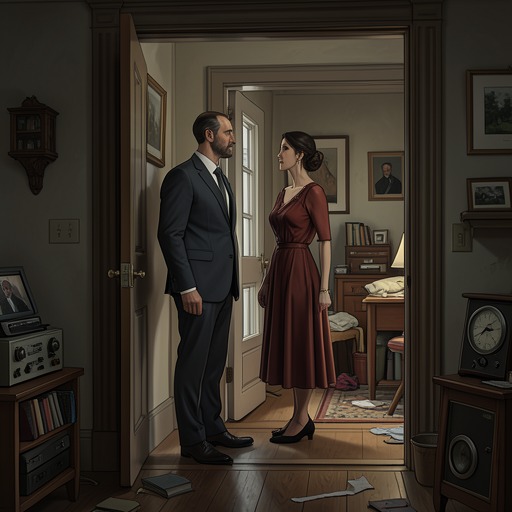
Babe knows of an old miner’s house at the edge of town where the group can stay if they clean it out. The shack is coated in dust, with a porch and a well behind it; Tim and Ray spend much of the afternoon and part of the night cleaning. The work is practical and collective, and the prospect of holding a large party gives the abandoned dwelling a new, temporary use. Girls in the street join the cleanup, and young singers from the opera chorus pitch in as well, briefly bringing the town’s different social worlds into the same effort.
Before the party, Sal, Tim, and Ray go to the rooming house used by the opera stars. They borrow razors, towels, hairbrushes, colognes, shaving lotions, and electric razors, then bathe and sing in the stars’ bathroom. Their excitement at using performers’ amenities is part of the weekend’s playful social trespass: they borrow the signs of refinement while preparing to return to a rough cabin and a boisterous night.
The evening moves between the opera district and the bars. Central City stands two miles high; at first, Sal says, the altitude intoxicates him, before fatigue gives way to a fever in the soul. The group approaches the opera-house lights, then turns sharply toward old saloons with swinging doors. They drink oversized beers beside a player piano, and the view from beyond a back door opens onto mountainsides in moonlight. Sal’s shout marks the night’s release into a different kind of performance, one not arranged for tourists or an opera audience.
Back at the miner’s shack, Babe and Betty Gray cook beans and franks. After the opera ends, crowds of young women arrive; the guests dance without music, bring bottles, and repeatedly rush out to the bars before returning. The gathering becomes more frantic as it grows. Sal wishes Dean and Carlo were present, then recognizes that they would be out of place and unhappy. He connects them instead with the dungeon singer and with the underground, sordid hipsters of America—a Beat generation he is only gradually joining. Central City therefore marks not simply a pause in the journey but Sal’s recognition that he is moving between social worlds without being fully at home in either.
Violence, Morning, and the Road Back
The revelry spills into conflict. In a bar, Ray knocks down an Argentine tourist after the man snarls at him when Ray shoves him to make room. Sal and Tim hurry Ray away amid screams and confusion; the sheriff cannot get through the crowd to find the victim, and nobody identifies Ray. Later, Ray returns to the bar and throws a highball in the face of the tenor known as D’Annunzio. Sal and Tim drag him out. At another bar Ray insults a waitress, and a group of hostile local men warns the visitors to leave by the count of ten. They do, returning to the shack to sleep.
Morning replaces the night’s velocity with its consequences. Dust rises from the mattress when Sal turns over; the window is nailed shut, and he and Tim cough and sneeze. Their breakfast is stale beer. Babe returns from her hotel, and the party breaks up. As the group prepares to leave, Babe slips and falls face-first; her brother, Tim, and Sal help her up. Major and Betty join them in the car, and the ride back to Denver is described as sad. Coming down from the mountain, they overlook Denver’s broad plain as heat rises from it, and the group sings. Sal, already impatient to continue west, is itching to get to San Francisco.
Only afterward does Sal learn that Dean and Carlo had also been in Central City. Carlo tells him that they ran through the bars, after which Dean stole a car and drove down the mountain curves at ninety miles an hour. Sal had not seen them, and they had not known he was there. The separate visits sharpen the episode’s central contrast: Sal’s weekend has been shaped by opera, a shared cleanup, a party, and its messy aftermath, while Dean’s parallel Central City passage takes the more dangerous form of a stolen car and a high-speed descent. The town briefly holds both versions of the road’s appeal—communal improvisation and reckless motion—before Sal returns to Denver and resumes looking west.